How to Stop Your City Pages From Looking Like Search Engine Bait
How to Stop Your City Pages From Looking Like Search Engine Bait
If you have been in the local search game for more than a minute, you know the drill. You want to rank in a dozen different suburbs, so you create a dozen different pages. You take your main service page, hit “Copy,” and then “Paste” twelve times. You go through and change the name of the city in the H1, sprinkle the city name in the meta description, and call it a day. For years, this was the “standard” way to handle service area business seo. But as we head into 2025 and 2026, that strategy isn’t just failing – it’s becoming a massive liability.
I’m Michael Pilko, and I’ve spent years helping businesses navigate the volatile waters of google business profile seo. I’ve seen the “Radius Drops,” the “AI Search Drift,” and the sudden de-indexing of entire websites because they relied on what Google now classifies as “doorway pages.” If your city pages look like search engine bait, Google is going to treat them like trash. It’s time to stop building hollow shells and start building high-value local assets.
Section 1: The “Doorway Page” Crisis
The local SEO landscape is currently facing a “Doorway Page” crisis. For the uninitiated, Google defines doorway pages as sites or pages created to rank highly for specific search queries but lead to multiple similar results. Essentially, they are “thin” pages that provide no unique value to the user beyond being a landing spot for a keyword. Research from Manning Marketing highlights a grim reality: doorway pages are duplicated, thin, or created solely to capture search queries without providing unique local utility. In the eyes of a 2026 algorithm, these pages are spam.
Why is this happening now? Because Google’s ability to detect pattern-based content has reached a tipping point. If your “Plumber in Dallas” page is 98% identical to your “Plumber in Fort Worth” page, Google’s systems flag it as a low-effort attempt to manipulate the index. This is why a standard Google Maps Action Plan: Winning Local Visibility in 2025 must evolve. You can no longer rely on the “find and replace” method. You need a strategy that proves to Google – and to your potential customers – that you actually exist and operate within those specific geographic boundaries.
The penalty for doorway pages isn’t just a lower ranking; it’s often a complete removal from the search results for those specific terms. Even worse, if Google identifies your site as a “doorway domain,” it can suppress your entire google business profile ranking. To survive the next two years, your city pages must transition from being “search engine bait” to becoming “hyperlocal community resources.”
Section 2: The Anatomy of “Search Engine Bait” vs. High-Value Assets
What does “search engine bait” actually look like? It’s easy to spot if you know what to look for. The red flags are everywhere: identical text across 50 different cities, a total lack of local imagery, and generic, robotic H1 tags like “Best [Service] in [City].” If a user lands on your page and can’t tell which city they are looking at without reading the text, you have a bait problem.
The Reddit SEO consensus is clear: location pages are only considered legitimate by modern algorithms when they contain unique local content and specific area information. If you are using google business profile seo techniques correctly, you understand that relevance is no longer just about keywords – it’s about context. A high-value asset provides information that is specific to the community it serves. It answers local questions, addresses local regulations, and reflects the local culture.
Compare these two scenarios:
- The Bait Page: “We are the best roofers in Springfield. We offer emergency roof repair in Springfield. Call our Springfield roofing team today.” (Repeat for 20 other cities).
- The High-Value Asset: “Our roofing crews have been serving the Springfield Heights and Downtown districts for over a decade. We specialize in repairing the specific hail damage common to the [Local Landmark] area after the spring storms. See our recent work near [Local Park] below.”
The second example uses rank google business profile strategies by grounding the business in reality. It provides “Proof of Presence.” To truly rank higher on google maps, your website must support your Google Business Profile (GBP) with local data that matches the “proximity, relevance, and prominence” pillars of local search.
Section 3: The “Proof of Service” Framework for 2026
As we look toward 2026, the algorithm is shifting toward what I call “Physical Proof.” Google is increasingly wary of AI-generated content and “ghost” service areas. They want to see “Proof of Transaction” and “Foot-Traffic Proof.” This is why your Why Your 2025 SEO Guide Destroys 2026 Local Shop Rankings if it doesn’t account for these new signals.
To implement the “Proof of Service” framework, every city page should include the following three elements:
1. Photos of Jobs Completed in That Specific City
Stop using stock photos. A photo of your truck parked in front of a recognizable local landmark or a house in a specific neighborhood is worth more than 1,000 words of “SEO content.” Even though Google often strips EXIF data, their computer vision AI can still recognize geographic markers. If you’re a landscaper in Phoenix, show me a picture of a desert-scape you designed with a Camelback Mountain backdrop.
2. Neighborhood-Specific Case Studies
Instead of a generic “About Us,” include a “Recent Projects” section. Mention neighborhoods by name. “Last week, we helped a homeowner in the Silver Lake district with a flooded basement.” This creates a semantic link between your business and that specific hyperlocal area, which is essential for google maps ranking service success.
3. Zip-Code Specific Reviews
Don’t just pull in your 500 latest reviews to every page. Filter them. If you are on the “Santa Monica” city page, show reviews from customers who actually live in Santa Monica. This signals to Google that your google business profile optimization is backed by real-world activity in that specific zone. This is a core component of any serious google maps seo strategy.
By providing this “Physical Proof,” you insulate your site against “AI Search Drift,” where search engines struggle to distinguish between a real local business and a lead-gen site operating out of a basement 500 miles away. You are telling the algorithm, “I am here, I am active, and I am trusted by these specific people.”
Section 4: Hyperlocal Content: Making the Page “Smell” Like the City
To truly differentiate your city pages, you need to make them “smell” like the city. This is a concept championed by the Local Visibility System, and it’s the secret sauce for hyperlocal seo. You want a human reader – and a Google bot – to feel the local atmosphere immediately. Using local seo tools can help you identify local trends, but the execution requires a human touch.
Here are four ways to inject hyperlocal flavor into your city pages:
- Mention Local Landmarks: “We’re located just five minutes south of the historic courthouse,” or “Our service technicians often grab lunch at [Famous Local Deli] between calls.” This isn’t just fluff; it builds geographical relevance.
- Provide Specific Driving Directions: Don’t just embed a map. Write out directions from major local intersections. “If you’re coming from the north via I-95, take the Main Street exit and head past the old water tower.” This helps with “proximity” signals and improves user experience.
- Highlight Community Involvement: Did your company sponsor a Little League team in that city? Did you participate in the local fall festival? Mention it. Link to the local event page. This creates a “prominence” boost that generic local seo services often overlook.
- Local Weather and Seasonal Issues: Address the specific challenges of that city. If you’re a plumber in a city prone to freezing pipes, write a section specifically about the local winter weather patterns and how they affect the local infrastructure.
When you include this level of detail, you aren’t just creating a landing page; you’re creating a resource. This is how you rank google business profile assets effectively – by making your website an undeniable authority on the local area. If you need help auditing your current content for these signals, using a google maps seo tools suite can help you see where you’re falling short compared to competitors who are already dominating the map pack.
Furthermore, avoid the 5 proximity errors that are wrecking your local ranking checklist right now by ensuring your content doesn’t claim to be “near” places that are actually 45 minutes away. Google knows the distance; don’t try to fool the map.
Section 5: Technical Signals & Map Integration
While content is king, technical signals are the queen that runs the palace. You need to bridge the gap between your website and your Google Business Profile through a sophisticated The Map Embed Strategy That Actually Moves the Needle on Local Search. A simple iframe isn’t enough anymore.
To maximize your google maps lead generation, your technical setup should include:
Advanced Schema Markup
You must use LocalBusiness schema, but don’t stop there. Use the `areaServed` property to explicitly define the cities and zip codes you cover. You can even use `hasMap` to link directly to your GBP CID link. This “forces” Google to recognize the relationship between your city page and your physical (or service area) business. If you’re unsure if your schema is correct, a google business profile audit tool is indispensable for catching errors before they hurt your ranking.
Optimized Map Embeds
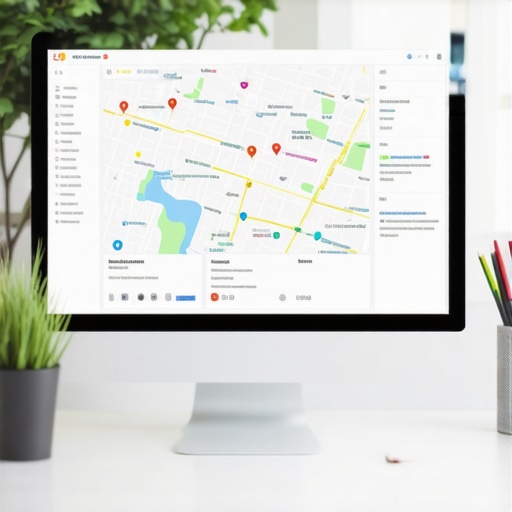
Instead of just embedding your business location, try embedding a map that shows directions from a prominent local landmark to your office (if you have a physical location). If you are a Service Area Business (SAB), embed a map that highlights your service radius. This reinforces the “relevance” pillar and helps you rank higher on google maps by showing consistent geographic data.
Internal Linking and Silos
Your city pages shouldn’t be orphans. They should be part of a logical internal linking structure. Link your city pages to relevant blog posts about local projects, and link from your main service pages to your specific city sub-pages. This helps pass “local authority” throughout your site. It also prevents the “Radius Drop” where your rankings disappear the moment a user moves a mile away from your center point.
Remember, the goal of these technical signals is to create a “Geographic Loop.” Your GBP points to your website, your website uses schema to point back to your GBP, and your city pages provide the content that proves the whole thing is real. This is the foundation of google business profile ranking in a post-AI world.
Section 6: Conclusion & The 2026 Local Dominance Plan
The days of “set it and forget it” city pages are over. If you want to dominate local search in 2025 and 2026, you have to stop thinking like a bot and start thinking like a neighbor. Google’s algorithm is getting smarter, and its tolerance for “search engine bait” is at an all-time low. By focusing on “Proof of Service,” hyperlocal content, and tight technical integration, you can build a local SEO presence that is immune to algorithm updates and AI disruptions.
To succeed, follow this 2026 Local Dominance Plan:
- Audit your existing city pages. If they are more than 80% identical, start rewriting them today.
- Gather “Physical Proof.” Get your teams in the field to take photos of their work in specific neighborhoods.
- Implement advanced LocalBusiness schema to tie your site and GBP together.
- Use google maps seo tools to monitor your rankings and adjust your strategy based on real-world data.
Don’t let your business get buried by the competition because you relied on outdated tactics. Take the time to build pages that actually serve your community. If you’re ready to take your local strategy to the next level, start by reviewing The Ultimate Local SEO Checklist for Boosting Your Business Ranking. It’s time to stop baiting and start building.